
This report covers
Ask most restaurant operators what drives catering growth and they'll say new customers. Run more ads. List on another marketplace. Discount the first order. It's the normal instinct, but it may be the wrong place to focus. The operators who are growing catering, not just keeping it alive, flip the script: catering isn't just a restaurant business. It's a B2B sales business. And because of that, the most powerful growth lever isn't finding new customers. It's building real, managed relationships with the ones you already have.
The number that reframes everything
Our data from 8,000+ locations over the last decade and nearly $1B in annual catering volume reveals a striking finding:

Let that sink in. The vast majority of your catering business is coming from a tiny slice of your customer base. They're office managers, executive assistants, pharma reps, and corporate buyers who order repeatedly, spend more per order, and have the potential to anchor your entire program.
The question every operator should be asking isn't “how do we find more customers?” It's “do we even know who our top 5% are, and what are we doing to keep them?”
In working with 100+ restaurant brands in the last decade, MONKEY sees these issues at our customers all the time, which typically fall into the following categories:
Catering programs struggle along without a CRM
Generic CRMs fail to handle complex catering-specific workflows
CRMs simply house data...versus actually igniting customers
In all three cases, the result is the same, revenue that should be recurring isn't.
1. Catering programs struggle along without a CRM
Without a CRM, you're flying blind. You know orders are coming in, but you don't know who your best accounts are, you can't tell which ones are at risk of going quiet, and you have no structured way to reach back out when they do. The only growth strategy available to you is hoping new orders keep arriving, which is both expensive and unpredictable.
The instinct is often to dump known data into a shared Excel or Google Sheet. But rarely does that capture data about who the corporate buyer is, what their preferences are, what payment terms they expect, or whether they're about to place their next order or quietly move to a competitor.
The other trap is over-relying on net-new order volume to measure growth. Acquisition is necessary, but it's the most expensive way to grow. If you're constantly replacing churned accounts with new ones, you're running hard to stay in place. The brands that compound growth are the ones converting first-time orders into second and third ones, and that requires a system, not good intentions.
There's also the first-party data problem. If you're taking orders primarily through marketplaces, you don't own the guest relationship, the marketplace does. You fulfilled the order, but you have no name, no email, no way to follow up. When you bring ordering onto your own channel with your own website branded experience, every order becomes a data point you own. And data you own is data you can act on.
2. Why generic CRM fails for catering-specific workflows
Most restaurant brands already have some version of a CRM, usually something inherited from their consumer loyalty program or cobbled together from their POS data. The problem is that catering buyers don't behave like consumer guests, and generic CRM tools aren't built for the way catering actually works.
What you need is a purpose-built, structured data system that makes catering relationships manageable at scale: industry, role, company, order patterns, delivery locations, payment preferences, dietary needs, a profile built around catering behavior, not consumer transactions. A few examples of where standard tools fall short:
Corporate account complexity. Catering buyers often have multiple delivery addresses, company billing accounts, tax-exempt status, and purchase order requirements. Consumer CRM tools have no concept of this.
The wrong person gets rewarded. Point-based loyalty often doesn't work in catering. The person placing the order isn't spending their own money, so “10% off your next order” doesn't land the same way.
No pipeline visibility. Catering sales has a pipeline: a lead becomes a prospect, a prospect becomes a first-time buyer, a first-time buyer becomes a repeat account. Generic tools don't model this.
No catering-specific outreach triggers. A guest who hasn't ordered in 45 days should get a re-engagement email. A corporate account that just placed their 10th order should get a personal follow-up.
3. CRMs that actually ignite customers, not just house data
The foundation is knowing who is ordering. Catering-specific CRMs capture and structure data that makes account relationships manageable at scale: industry, role, company, order history, delivery preferences, payment terms. That profile lets you identify your top accounts before they go quiet, spot over-performing segments, and flag accounts at risk of drifting back to a marketplace.
A well-functioning CRM allows outreach to be targeted instead of generic. Automated re-engagement emails go out to guests who haven't ordered in a set number of days. Quote follow-ups fire at the right moment in the sales cycle. Sales reps have clear ownership over their territories and accounts. Management has visibility into what's in the pipeline, where deals are stalling, and which reps are converting.
MONKEY is actively investing to expand the surface area of the CRM using AI to surface the insights buried in your account data: which customers are most likely to reorder soon, which accounts show patterns that precede churn, where the highest-value opportunities in your pipeline actually are.
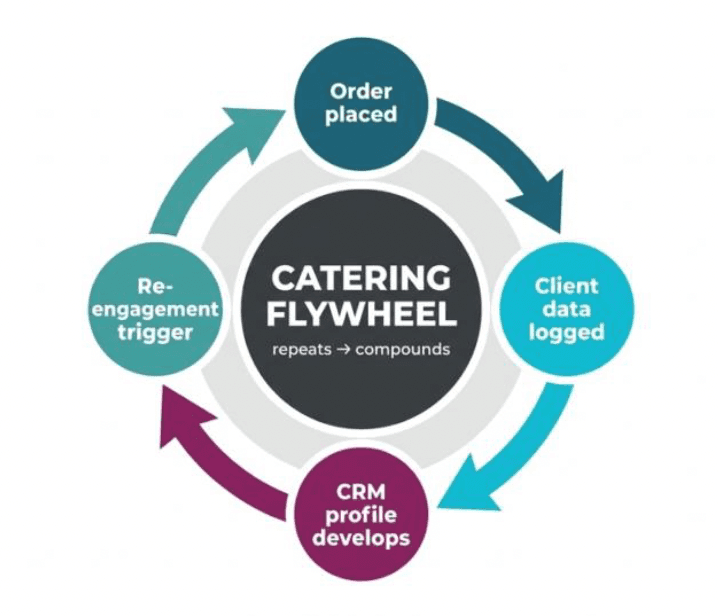
What is the takeaway?
Get to know your customers. Show up on time. Nail the food. Make the person who ordered look good in front of their team. Do that consistently, and you won't need to buy their loyalty.
But once you're executing well, the CRM layer is what scales it. It's what lets you manage 50 corporate accounts with the same attentiveness you'd give 5. It's what catches the account that's gone quiet before they're gone. It's what turns a great first impression into a durable revenue relationship.
That's the shift. Catering isn't a channel you manage. It's a set of relationships you nurture. And like any relationship worth keeping, it requires intention, the right systems, and showing up consistently, not just when you need something.
Catering isn't a channel you manage. It's a set of relationships you nurture.
© 2026 MONKEY Catering Platform. All rights reserved. · monkeymediasoftware.com
Hand-picked reads from inside the jungle
Curated articles, announcements, and deep dives handpicked by the MONKEY Media Software team."

Standardize Without Strangling: The Multi-Location Catering Paradox
PRODUCT
Jun 2025
The 5 Stages of Catering Maturity: Where Does Your Brand Stand?
INSIGHTS
Jun 2026

Catering is not takeout. Mixing it together stifles growth.
INSIGHTS
Jun 2026