
This report covers
Every successful multi-unit restaurant brand has figured out the same thing: some things need to be consistent everywhere, and some things need to flex by market. Core brand identity, food quality, guest experience standards, those travel. Pricing, local menu adaptations, promotional strategy, those often don't, and the best operators know it.
Catering is no different. A well-run catering program needs the same mix: brand standards and operational guardrails that hold across every location, paired with the flexibility for each market to price appropriately, adapt the menu to local demand, and make day-to-day operational decisions without waiting on corporate approval.
The problem is that not all software was built for this. The tools that exist were designed for simpler operations, single locations, or multi-unit brands where catering is an afterthought. They offer a choice between locking everything down centrally or giving every location a blank canvas. Neither works.
Catering operators deserve the balance. Enterprise-level consistency where it matters, genuine location-level flexibility where it doesn't.
Four ways corporate control derails local catering success
Before looking at what works, it's worth being specific about what goes wrong. These four failure modes show up repeatedly across multi-unit catering operations, and most operators will recognize at least one of them.
1. The locked menu problem
Corporate creates a standardized catering menu and locks it across all locations. The Miami location can't add items with strong local demand. The Chicago location is stuck with offerings that don't move in their market. Seasonal additions require a corporate approval process that outlasts the season.
THE RESULT: Stores lose catering sales to competitors who can adapt. Corporate ends up maintaining a lowest-common-denominator menu that works everywhere but excites no one. Operators stop investing in catering because they have no agency over it.
2. The financial black box
In traditional franchise systems, catering finances are managed centrally and stores have little visibility into their actual performance. They can't see catering revenue separated from dine-in. They can't adjust pricing based on local cost fluctuations. Month-end close becomes a manual allocation exercise that takes days.
THE RESULT: Stores can’t manage catering as a real profit center because they lack basic financial controls. They stop investing time in growing catering sales because they have no line of sight into whether that investment is paying off.
3. Permission paralysis
Every operational decision requires escalation. “Can we extend our lead time for Thanksgiving week?” “Can we increase our minimum order size for December?” Operators wait days for approvals on time-sensitive decisions. Opportunities slip away while the email thread grows.
THE RESULT: Corporate becomes a bottleneck instead of a support system. Stores feel micromanaged and disengage. The most capable operators (the ones most likely to build a strong catering program) are the most frustrated by the constraints.
4. The privacy problem
Corporate dashboards give all stores visibility into each other's performance. Corporate may see this as healthy benchmarking. Stores see it as a competitive threat, especially in markets where multiple franchisees operate in proximity.
THE RESULT: Stores resist using the system properly, implement workarounds, or simply stop entering data accurately. Trust between corporate and operators erodes, and the data that should be powering growth decisions becomes unreliable.
What enterprise-grade configurability actually looks like
The alternative to rigid standardization isn't giving every location a blank canvas, it's building a system where corporate sets the framework and locations configure within it. Every operator works inside a consistent platform, but each has the autonomy to make that platform work for their market.
Menu flexibility without brand chaos
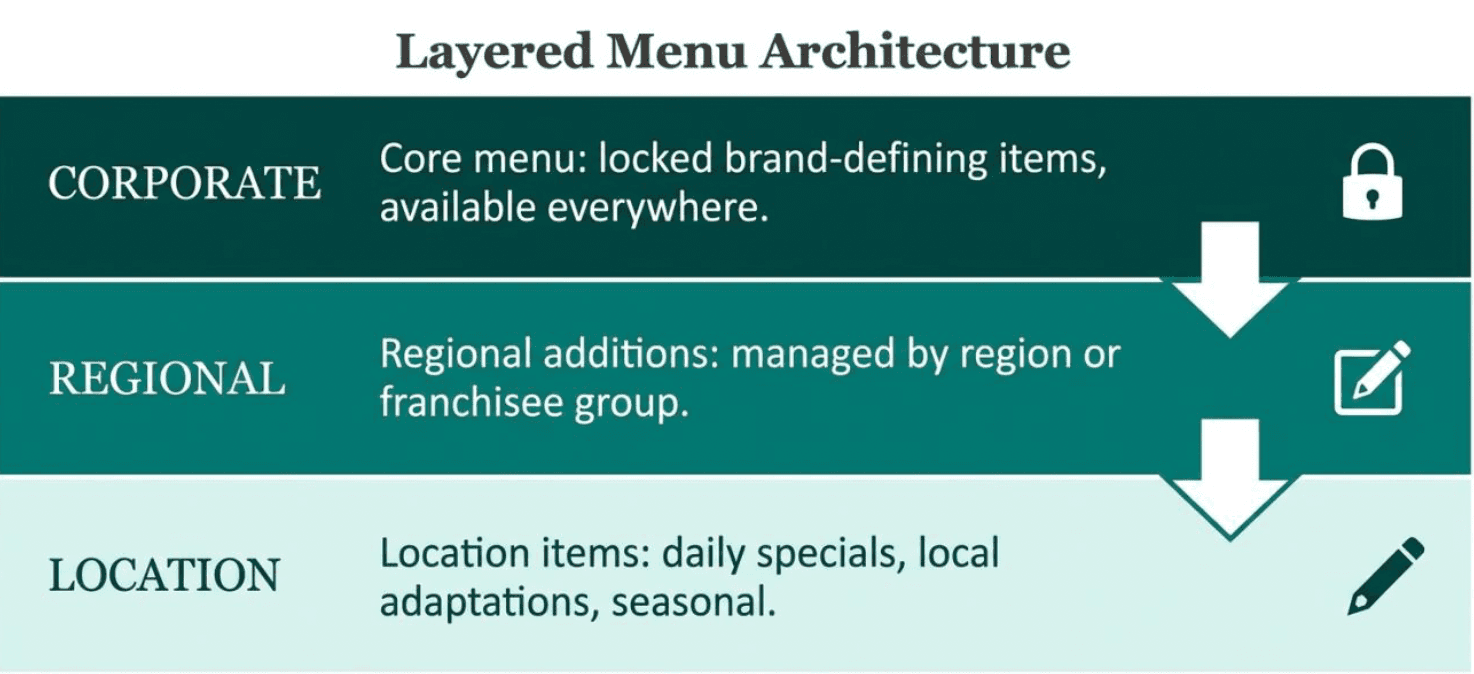
The best multi-location catering systems treat menus as layered, not binary. There’s a core of brand-defining items that appear everywhere and the signature offerings that define who you are. Layered on top are regional additions that locations can manage themselves: items that resonate in their market, seasonal offerings tied to local availability, menu changes that don’t require a corporate ticket to execute.
Most systems can’t handle this level of temporal complexity. It’s one of the clearest signals of whether a platform was built for enterprise scale catering or adapted to it.
Financial control at the location level
Each location should have genuine control over the economic levers that determine their catering profitability: menu pricing, order minimums, delivery fees by zone, service charges, gratuity settings, and up-charges for customizations. A breakfast box is $89 in Kansas City and $129 in San Francisco, and both prices make sense for their respective markets. The system should support that without requiring corporate intervention.
For franchise environments specifically, the financial infrastructure needs to go further: separate invoicing by location or franchisee, support for different POS systems across the network, pre-authorizations and deposit collection, and accounts receivable management that handles the complexity of corporate accounts with net terms. These aren’t edge cases, they’re the normal operating requirements of any serious multi-unit catering program.
Permissions that respect the corporate vs. store relationship
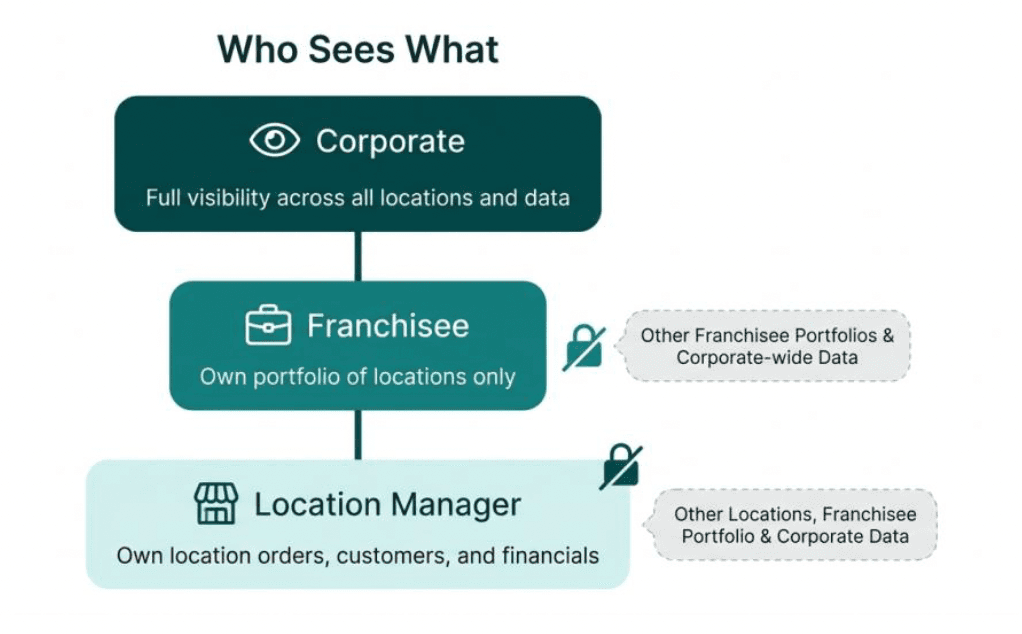
The right approach is layered visibility: store operators see their own location's orders, customers, and financials, and nothing else. A franchisee who owns multiple locations gets consolidated visibility across their portfolio, but not into other franchisees' performance. Corporate sees everything they need to support the network and identify best practices.
Within that permission structure, location managers should be able to handle routine operational decisions themselves, such as adjusting lead times for a busy season, blocking out dates for kitchen maintenance, running location-specific promotions, without filing a request with corporate.
Why this matters more as you grow, not less
The implication is straightforward: if you're planning to grow catering across multiple locations, build on a platform that supports enterprise-level configuration from the start. The brands that tell themselves they'll “upgrade later” consistently find that migration becomes painful once real catering revenue is flowing through the system. You outgrow limited tools faster than you expect, and the cost of switching mid-stride: operational disruption, data migration, and retraining is far higher than getting the infrastructure right early.
The brands that tell themselves they'll upgrade later consistently find that migration becomes painful once real catering revenue is flowing through the system.
© 2026 MONKEY Catering Platform. All rights reserved. · monkeymediasoftware.com
Hand-picked reads from inside the jungle
Curated articles, announcements, and deep dives handpicked by the MONKEY Media Software team."
The 5 Stages of Catering Maturity: Where Does Your Brand Stand?
INSIGHTS
Jun 2026

Catering is not takeout. Mixing it together stifles growth.
INSIGHTS
Jun 2026

The State of Catering 2026: What the Data Is Really Telling Us
INSIGHTS
Jun 2026