This report covers
Most restaurants do some version of catering, whether they call it that or not. Maybe it starts with a phone call for a big order that someone figures out on the fly. Maybe there's a laminated sheet behind the counter that regulars know to ask for. Maybe it's a few platters tucked at the bottom of the online menu.
It works, until it doesn't. Because at a certain volume, the workarounds stop working. Orders get missed, kitchens get blindsided, and the person who placed a $600 order gets the same experience as someone who ordered a sandwich. The cracks start showing and guest experience starts to feel like an afterthought.
The problem isn't execution. The problem is that catering is a fundamentally different business from takeout, and the tech built for one simply cannot run the other well.
The numbers tell the story immediately
The most obvious difference is the order itself. A typical delivery order runs $25-35, exposes the brand to 1-2 guests, and only ~25% of those guests will ever return. A catering order averages $416 with highly lucrative, recurring customers (nearly 60% of orders coming from 5% of guests) and exposes your brand to 10+ additional future customers. That's not a bigger version of the same transaction. It's an entirely different commercial relationship.

A $416 order for a client lunch or office event? One missed item, one wrong delivery time, one payment friction, and that account doesn't come back. And unlike a bad takeout experience that stays between you and one guest, a catering failure plays out in front of an entire room. The 20 people who didn't get what they needed remember which brand was responsible.
It's a B2B sale, not a B2C transaction
Takeout buyers are consumers. They're hungry, they're in the moment, and they make decisions in seconds. Catering buyers are office managers, executive assistants, pharma reps, event planners, and department heads. They're planning for other people, managing budgets, and often making repeat purchases on a schedule. They expect the option to pay on a house account and receive an invoice after the fact. And if they're paying by card, they expect that card not to be pre-authorized and charged until close to the event, not the moment they order, leaving them with a hold tying up their funds in the meantime.
This distinction changes everything about how catering needs to be sold, fulfilled, and retained. Unlike takeout, catering demands that you actually know your customers: their preferences, their payment terms, their order history, the notes from the last time something went wrong. You're managing invoices, tracking account-level sales figures, and actively working to turn every order into the next one. These are not consumer relationships, these are relational, B2B accounts.
Your takeout platform was built for a consumer deciding what to eat tonight. Your catering buyer is a procurement decision-maker planning next Thursday's board lunch.
The operational complexity is orders of magnitude higher
A takeout order hits the kitchen and gets made. A catering order requires production planning, sometimes days in advance, across potentially multiple locations, with specific setup requirements, delivery windows and a guest who expects someone to be accountable if anything goes wrong.
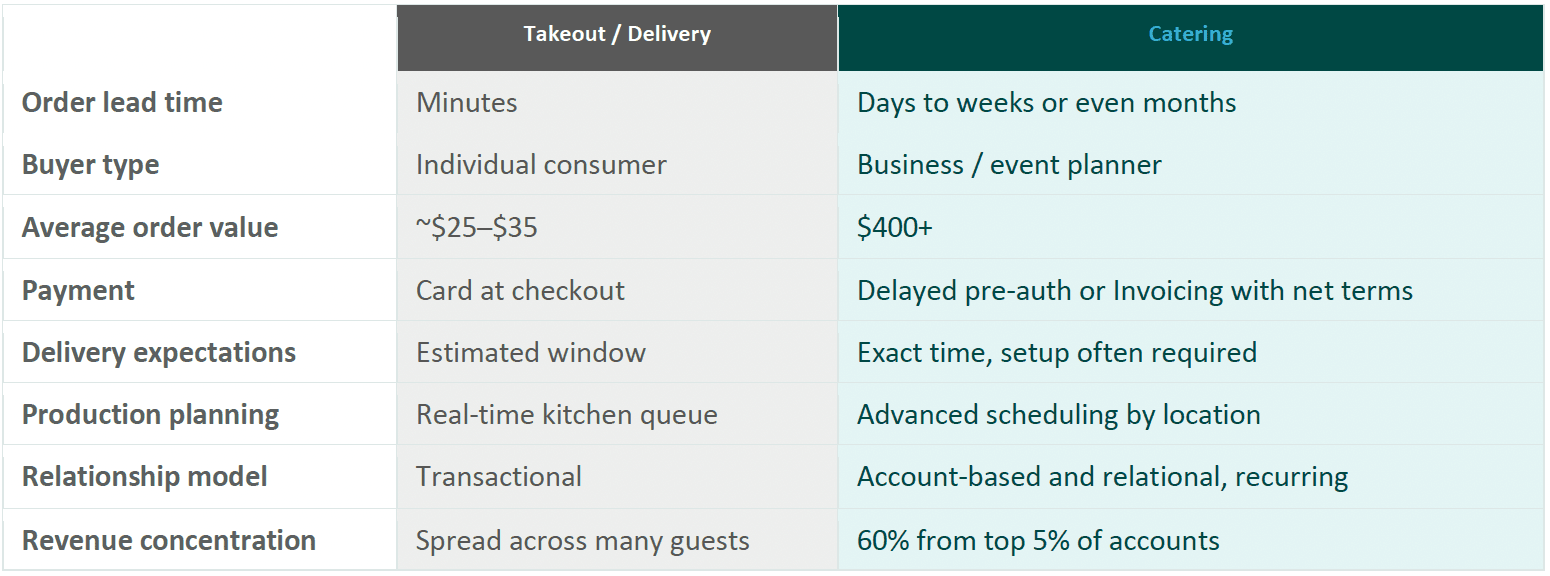
Generic online ordering platforms handle none of this well. They have no concept of advance production cutoffs, no invoicing engine, no account-level CRM, and no delivery management built for scheduled, multi-stop routes. Brands running catering on these platforms are essentially duct-taping a consumer tool onto a B2B operation, and their teams feel it every single day.
What a purpose-built catering stack actually needs
The brands outpacing the market aren't using better versions of takeout tools. They've built around a stack intentionally designed for how catering actually works. That means five things working together:
1. First-party online ordering built for catering
Not a consumer checkout flow. A catering-specific ordering experience that handles lead times, headcount, dietary options, scheduling, and a professional confirmation flow, all on your own branded site, not a marketplace.
2. Order management and production coordination
Advanced scheduling, location-level production views, and the operational backbone to execute orders on time at scale. This is where catering operations live or die, and where generic POS systems fall apart.
3. CRM and account management
A catering CRM isn't a loyalty program, it's a B2B sales tool. Who are your top accounts? Which ones haven't reordered in 60 days? Who do you call? This is the engine that turns catering into a proactive revenue channel.
4. Delivery management and last-mile control
In 2026, in-house delivery accounts for 53% of catering orders, up from 31% in 2021. Brands are taking control because the delivery experience is the guest experience.
5. Order editing with built-in guardrails
Catering orders change. Headcounts shift, dietary needs get added, delivery times move. A purpose-built platform gives guests a self-serve way to modify their own orders within defined windows, no phone tag, no manual updates. And when a catering team needs to make a change on the backend, those edits flow through automatically: updated production tickets, revised invoices, adjusted delivery manifests. The kitchen isn't blindsided. Accounting isn't chasing corrections. Everyone works from the same updated order.
The cost of getting this wrong is compounding
There are now more than 100,000 restaurants offering catering in the US alone. More options mean more discerning buyers and guests who have experienced a great catering program now expect that standard everywhere. For brands still running catering as an afterthought, that shift in expectations is unforgiving.
The brands running catering on generic tech aren't just operating inefficiently today, they're falling further behind every quarter. The operators who built on the right stack early now have years of account data, refined production workflows, and guest relationships that are genuinely difficult to displace.
The window to build a real catering advantage is still open. But the gap between brands running purpose-built catering infrastructure and those still on consumer tools is already meaningful, and it widens every year.
Catering is not a bigger takeout order. It's time the technology reflected that.
© 2026 MONKEY Catering Platform. All rights reserved. · monkeymediasoftware.com
Hand-picked reads from inside the jungle
Curated articles, announcements, and deep dives handpicked by the MONKEY Media Software team."

Standardize Without Strangling: The Multi-Location Catering Paradox
PRODUCT
Jun 2025
The 5 Stages of Catering Maturity: Where Does Your Brand Stand?
INSIGHTS
Jun 2026

The State of Catering 2026: What the Data Is Really Telling Us
INSIGHTS
Jun 2026